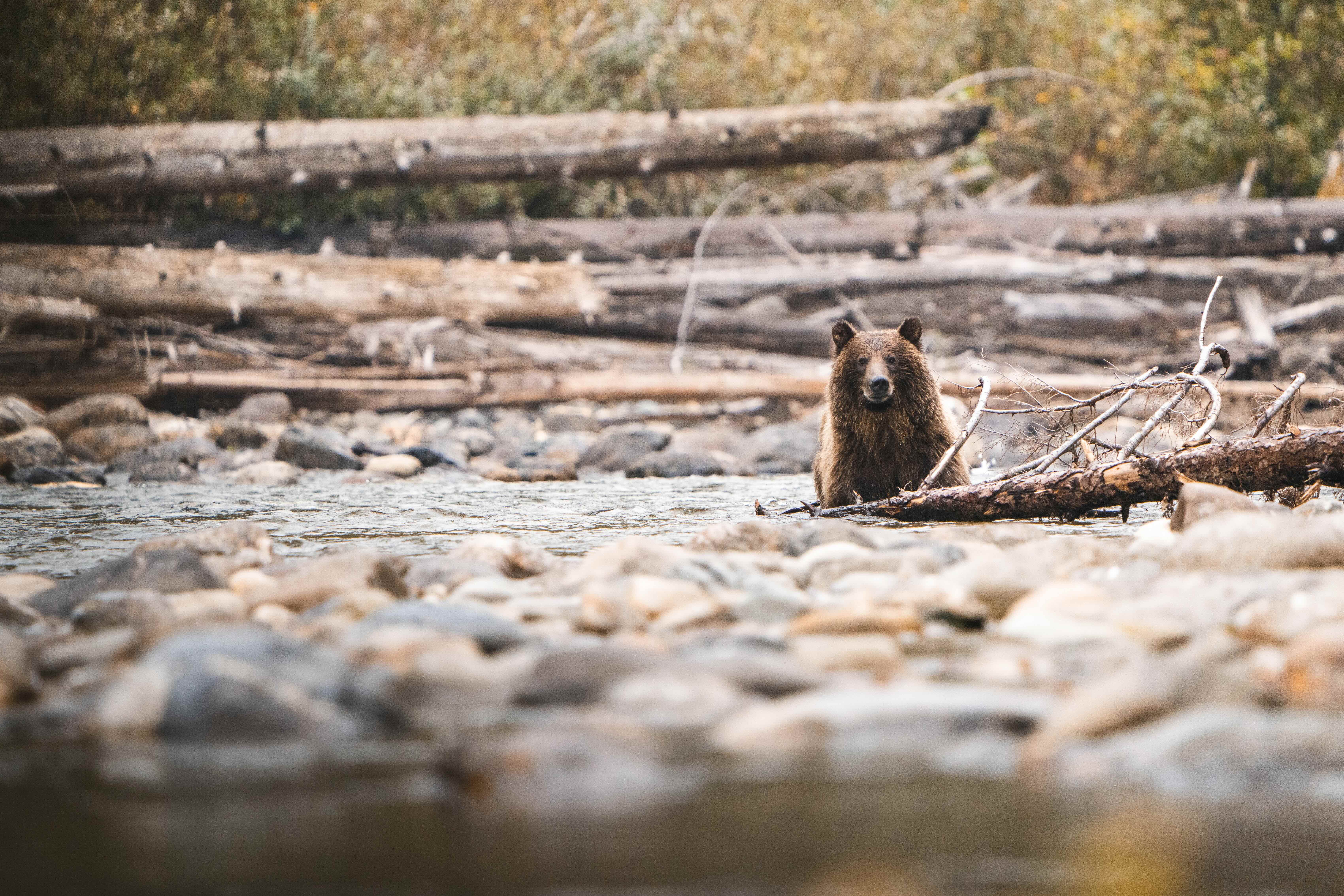
In the 20 years I have been running Wild Bear Lodge some questions have come up again and again.
One is whether guests who are spending their hard-earned savings to see bears in the wild should come to our lodge deep in British Columbia’s interior temperate rainforest – or whether they should head for the coast.
I have my views, but I accept that after two decades of viewing bears far from the tourist crowds – or indeed any crowds – I may be a little biased. So instead of sharing those with you, I have asked Bryn Mitchell to address the question.
Bryn is in a unique position to do this. He has guided for us for several years at Wild Bear Lodge. And he also guides regularly on the BC coast. Here are his thoughts. Photo by Alex Crouzet.
It is no secret that bear-viewing in British Columbia is about as good as it gets anywhere.
From the fog-wrapped coastline of the Great Bear Rainforest to the granite spine of the Rockies, this province leaves visitors spoiled for choice.
But one of the trickier decisions is whether to go looking for bears on the coast, or in the lesser-known interior.
I have spent years guiding in both places, and I can honestly say it isn’t a question with a fixed answer.
It comes down to what sort of wilderness experience you’re after — and, frankly, what sort of person you are.
Let’s start with the coast.
You sit beneath the towering, mist-draped peaks of the Coast Range, rock walls so high they seem to make their own weather as Pacific storms crash into them.
The air smells of salt and kelp. Somewhere below you a bear is turning over rocks in the inter-tidal zone, hunting for mussels with unhurried confidence.
Coastal bears, as a rule, are bigger than their inland cousins. It’s simple economics — more food, more bear.
Like every bear in the province, diet shifts with the calendar. Sedges in spring. Salmonberries and huckleberries through the summer.
And then, come fall, the main event: wave after wave of salmon returning to the exact stream they were born in, an act so precise it seems miraculous.
The viewing on the coast is reliable enough that entire estuaries are now dotted with boats and platforms, like grandstands at a sporting fixture.
A typical day at one of the coastal lodges goes something like this.
In spring and summer you climb into a skiff – a flat-bottomed aluminum boat for six or twelve passengers — and your guide takes you out to an estuary or a sheltered cove.
You might spend an hour out there, or several, cruising or sitting tight in spots where bears tend to show up.
When one does, the guide goes to work, easing the boat into position, reading the wind, the tide, the bear’s mood, a dozen other variables.
Sometimes that means watching from a hundred metres off. Other times it means sitting across a narrow channel close enough to hear the animal breathing.
Come fall the same operators move guests onto viewing platforms above spawning channels or reliable fishing spots. Time slots are agreed between different operators so everyone gets a turn. It is calm, it is orderly, and it works.
Bear-viewing in the interior is an altogether different animal – if you’ll forgive the pun.
The Lardeau Valley, home to Wild Bear Lodge, is buried deep in the Selkirks, a subrange of the Columbia Mountains that seems designed by nature specifically to keep people out.
There is no quick and easy way in. You have to want it. And that is precisely why the valley stays quiet – which is the way bears like it.
Down at valley bottom bears here graze on grass, horsetail and dandelions in May and June.
As the season warms and the snowline retreats up the mountainsides, they follow the new growth upward, the way you might chase the last of the sun on a beach.
By midsummer they’re up in the sub-alpine gorging on berries.
Come fall they drop back down to the river for kokanee — a landlocked species of sockeye salmon.
Viewing here is more work. Nothing your average guest can’t manage, but it is no couch-to-bear proposition. It asks something of you. And in my experience, the things that ask something of you tend to be the ones you remember.
Most days start with a short drive down a dirt road, and then you’re on your feet.
In the fall each guide leads a very small group of guests along trails that give a line of sight to the river, watching for bears working the salmon.
Our guides — some of whom have walked these trails for so long they could probably do it blindfolded — keep in touch on small handheld radios.
If you’re a photographer, the two experiences are quite different.
Chasing frame-filling close-ups? The coast will probably serve you better. The platforms offer a fairly reliable success rate and a roof over your head.
But something is lost too. Call it adventure, or unpredictability, or whatever it is that makes a photo more than just a photo.
If what you’re after are images tangled up with a memory – a picture that comes with a story attached – then the interior is where you want to be.
You end up with photographs rooted in a time and a place: sitting on a silent riverbank, the water rushing past, an eagle somewhere overhead, long stretches of nothing before the bear suddenly appears.
It is rougher round the edges. Less composed. A good deal wilder.
For what it’s worth – and I say this as someone who has spent a good deal of time in both places – I prefer the interior. It is more demanding but it feels, to me, more visceral, more honest.
There is simply nothing quite like being out in bear country, reading their tracks and sign, walking in silence beside a river the colour of blue-green glass, and letting nature decide, on its own terms, just how many bears you see.
Read more of The Grizzly Bear Dairies on Substack.